

I’ve learned that you don’t need heavy cream to make creamy soup. This is my go-to version when I want comfort food without feeling weighed down. Silky texture, deep flavor, ready in 30 minutes. I think you’ll find it’s just as satisfying.
Why This Recipe Works
I developed this recipe because I was tired of the guilt that comes with heavy cream-based soups. Don’t get me wrong—I love cream. But every time I made traditional creamy soup, I felt like I needed a nap afterwards. I wanted something lighter that still tasted incredible.
What I discovered is that creaminess doesn’t come from fat alone. It comes from proper technique. A good roux (butter and flour), combined with regular milk, creates a silky texture that’s just as satisfying. The secret is understanding how starch thickens liquid and how to build layers of flavor without relying on heavy ingredients.
I make this soup constantly now. My family loves it. Guests never believe it doesn’t have cream. It’s healthy enough that I don’t feel guilty serving it multiple times a week, but rich enough that everyone asks for seconds.
I’ve learned that this roux-and-milk technique applies everywhere in my cooking. When I’m making Easy Chicken Pasta Without Cream, I use the same principle—pasta water plus butter and cheese create richness. When I teach people to make Easy Chicken Meal Prep Bowls, I explain that good components together beat heavy techniques. And when I’m using Lemon Chicken No Oven as a base, I apply the same balanced thinking.
Ingredients
Serves 4-6 people (30 minutes total)
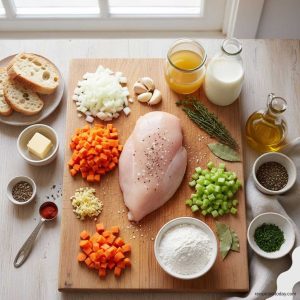
For the Chicken
- 500g (1.1 lbs / about 3 medium) boneless chicken breasts or thighs
- 15 ml (1 tablespoon) cooking oil
- 3g (½ teaspoon) salt
- 2g (¼ teaspoon) black pepper
For the Base & Creaminess
- 30g (2 tablespoons) butter
- 1 large onion (200g / 7 oz), finely chopped
- 2 large carrots (200g / 7 oz), diced
- 2 celery stalks (100g / 3.5 oz), diced
- 3 cloves garlic (9g / ⅓ oz), minced
For the Roux (The Magic)
- 30g (2 tablespoons) all-purpose flour
- 720 ml (3 cups) chicken broth
- 240 ml (1 cup) whole milk or 2% milk
For Flavor
- 3g (½ teaspoon) dried thyme (or 2g fresh thyme)
- 2g (½ teaspoon) dried parsley
- 1 bay leaf
- 3g (½ teaspoon) salt (adjust to taste)
- 2g (¼ teaspoon) black pepper
Optional Garnish
- Fresh parsley
- Cracked black pepper
- Crusty bread for serving
Equipment I Use
- 1 large pot or Dutch oven (5-quart / 5-liter)
- 1 wooden spoon or spatula
- Knife and cutting board
- Paper towels
- Measuring cups and spoons
How I Cook It
My Prep (5 minutes)
- I cook the chicken first: I heat cooking oil in my large pot over medium-high heat. I season the chicken with salt and pepper. I place it in the hot oil and cook for 6-7 minutes per side until it’s cooked through with no pink inside. I transfer it to a cutting board. Once it’s cooled enough to handle, I cut it into bite-sized pieces and set aside.
- I prepare all my vegetables: I’ve learned that having everything cut and ready before I start cooking makes everything smooth. I finely chop the onion, dice the carrots and celery, and mince the garlic. I line them up so I’m ready to go.
My Cooking Process (25 minutes)
- I start with the vegetables (8 minutes): In the same pot (I don’t wash it—those browned chicken bits add flavor), I melt butter over medium heat. I add the chopped onion, carrots, and celery. I stir occasionally and cook for 5-6 minutes until the vegetables are soft and fragrant. Then I add the minced garlic and cook for another 30 seconds until it smells amazing. I watch carefully—I’ve burned garlic before.
- I add the herbs (1 minute): I stir in thyme, parsley, and the bay leaf. I cook for just 30 seconds until I can smell the herbs blooming. This is when the flavor foundation really starts coming together.
- I make the roux—this is the key (2-3 minutes): I sprinkle flour over the vegetables. I stir constantly for 1-2 minutes. This cooks out the raw flour taste and creates my thickening base. I’ve learned this is the most important step. I don’t rush it.
- I add the broth slowly (3 minutes): I reduce the heat to medium-low. This is crucial—I’ve learned from mistakes that high heat can cause problems. I pour the broth in gradually while stirring constantly. I start with 120 ml (½ cup), stir well, then add more. I’m patient here. This slow addition prevents lumps, which I’ve dealt with too many times.
- I add the milk (2 minutes): Once all the broth is incorporated and smooth, I slowly pour in the milk while stirring. I keep stirring until everything is completely combined and smooth.
- I bring it to a gentle simmer (3 minutes): I increase heat to medium and bring the soup to a gentle simmer, stirring frequently. I watch it thicken as it simmers. The soup will coat the back of a spoon when it reaches the right consistency—usually takes 2-3 minutes.
- I return the chicken (1 minute): I add the cooked chicken back into the pot. I stir gently to combine everything.
- I let it simmer together (3 minutes): I reduce heat to medium-low and let the soup bubble gently for 3 minutes. This lets all the flavors come together. I stir occasionally.
- I taste and adjust (1 minute): I taste my soup. Does it need more salt? More pepper? I adjust it to my preference. I remove the bay leaf. I might squeeze in a bit of lemon juice if I think it needs brightening.

What I’ve Learned Over Time
- I don’t rush the vegetable phase: I’ve learned that golden, soft vegetables create natural sweetness and depth. Taking 6-8 minutes here is where flavor comes from.
- I stir constantly when adding broth: This has prevented lumpy soup disasters more times than I can count. Patience during this step saves the entire dish.
- I use whole milk when I can: I’ve tried 2% milk, and while it works, whole milk creates better texture. The difference is noticeable.
- Low to medium-low heat matters: I’ve had milk separate or soup break when I used high heat. Gentle heat is always my approach now.
- Patience with the roux pays off: I’ve learned that this step is what separates good soup from mediocre. The 1-2 minutes I spend here makes a massive difference.
- I apply the sear principle everywhere: Just like I learned from Quick Shredded Chicken in Pan, I pat my chicken dry before cooking. Moisture prevents browning and creates steam instead of sear. This applies to any protein.
Variations I Make
When I want to change things up:
- Lemon herb: I add 15 ml (1 tablespoon) fresh lemon juice and fresh thyme at the end
- Mushroom version: I sauté sliced mushrooms with the aromatics first
- Potato soup twist: I add diced potatoes with the broth
- Noodle soup: I add 150g (2 cups) cooked egg noodles in the final minute
- Spinach addition: I stir in 200g (4 cups) fresh spinach at the end—it wilts instantly
- Spicy version: I add a pinch of cayenne pepper or red pepper flakes
- Parmesan finish: I stir in 30g (½ cup) grated Parmesan cheese before serving
When I Don’t Have Everything
Here’s what I do:
| Need | What I Use |
|---|---|
| Whole milk | 2% milk (works but is less creamy), or half-and-half |
| Chicken broth | Vegetable broth or water (water is thinner) |
| Butter | Olive oil |
| Fresh thyme | Any dried herb, oregano, or parsley |
| Carrots | Any vegetable I have (celery, zucchini, green beans) |
| Flour | Cornstarch (use 15g / 1 tablespoon) mixed with water |
How I Store & Use It
In My Fridge
- I let it cool completely first
- I keep it in airtight containers
- It lasts about 4-5 days
- I love that leftovers taste even better
In My Freezer
- I cool it completely before freezing
- I freeze it in containers for up to 1 month
- I thaw it overnight in the fridge
- I reheat gently on the stovetop
How I Reheat It
- On the stovetop: I pour it into a pot over medium-low heat, stirring occasionally, for 5-10 minutes until heated through (never boiling)
- In the microwave: I use 50% power for 1-2 minutes, stirring halfway through (less ideal but fast)
Important: I’ve learned that high heat after reheating can cause milk to separate. Gentle is always my approach.
How I Serve It
I like to pair this soup with:
- Crusty bread for dunking
- Simple green salad
- Grilled cheese sandwich
When I’m making One-Pan Chicken and Rice Quick Recipe, I sometimes serve soup as the broth base for that dish. Or I’ll top the soup with shredded chicken prepared using Spicy Chicken Marinade Simple for extra flavor. Sometimes I use Easy Chicken Tacos for Beginners seasoning on the chicken to add different dimensions to the soup.
Questions I Get Asked
Q: My soup is lumpy. Can I fix it?
A: I’ve done this too many times. If it happens, I pour it through a fine mesh strainer and push it through. Or I use an immersion blender. For next time, I remember to add broth slowly while whisking constantly.
Q: The soup is too thin.
A: I simmer it for 3-5 more minutes. Water evaporates naturally and it thickens. Or I make a cornstarch slurry (5g cornstarch + 15 ml water) and stir it in while simmering.
Q: The milk looks weird or separated.
A: I’ve had this happen when the heat was too high. I lower the heat immediately and stir constantly. It still tastes fine even if it looks odd.
Q: Can I use rotisserie chicken to save time?
A: Absolutely! I shred the meat and skip the cooking step. I add it in the final minute just to warm through. Saves me 15 minutes and I don’t lose anything in taste.
Q: Why didn’t my roux thicken the soup?
A: Either the flour was cooked too much at high heat, or I didn’t use enough. I use 30g flour per 720 ml broth. I also make sure to cook the flour and butter together for 1-2 minutes before adding broth.
Final Thoughts
This soup is proof that light doesn’t mean boring. I’ve served it to friends who expected heavy cream soup, and they were shocked when I told them what it actually was. Creamy, satisfying, and guilt-free—that’s my kind of cooking.
I make this when I want comfort food. I make it when someone’s sick because it’s nourishing but easy to digest. I make it ahead for busy weeks because it reheats beautifully.
This is real, practical cooking that actually fits into my life.


Pingback: Creamy Tomato Soup Easy | 30-Minute Homemade Recipe