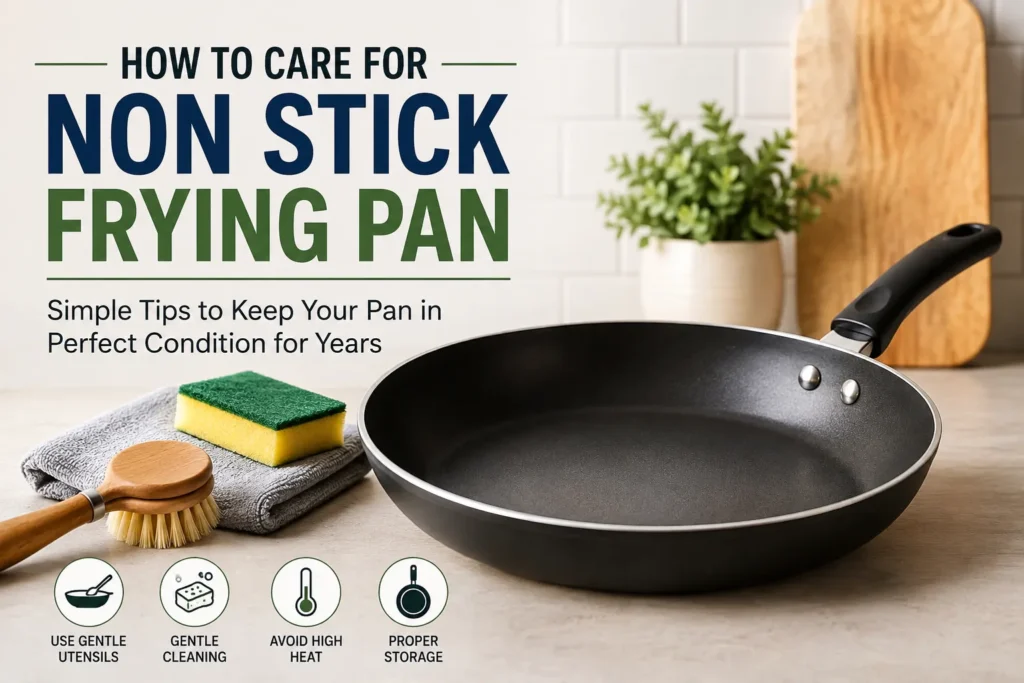
Quick answer: To care for a non-stick frying pan, cook on low to medium heat, use only wood, silicone, or plastic utensils, hand wash with a soft sponge and mild soap, dry it fully, and store it where nothing can scratch the coating. Avoid metal tools, cooking sprays, and the dishwasher.
Your non-stick pan looked perfect for the first few months. Now eggs stick. The coating looks dull. Something feels off.
You’re not imagining it, and you’re not alone. Most non-stick pans don’t fail because they were cheap. They fail because of small daily habits that quietly wear the coating down.
I’m Claire Bennett, and I’ve spent years testing recipes, kitchen tools, and cooking techniques in my own kitchen. I focus on simple, practical advice that helps home cooks make better meals with less stress. In this guide, I’ll walk you through exactly how to clean, season, store, and troubleshoot a non-stick pan so it keeps performing like new for years instead of months.

What Is Non-Stick Cookware, and Why Does Care Actually Matter?
A non-stick pan has a coating bonded to the metal base that keeps food from sticking without needing much oil or butter. That coating is the entire reason the pan works — and it’s also the part that wears out first.
Unlike stainless steel or cast iron, the non-stick layer can’t be scrubbed hard, scraped, or overheated without breaking down. Once it’s damaged, food starts sticking again, and there’s no way to repair the surface. Good daily habits are what determine whether a pan lasts six months or six years.
How Non-Stick Coatings Work (The Simple Science Behind It)
Non-stick pans generally use one of two coating types, and knowing which one you own changes how you should care for it.
PTFE (Teflon-Style) Coatings
PTFE is a smooth polymer coating that creates an extremely low-friction surface. It handles everyday cooking well but is sensitive to very high heat and sharp utensils. Most manufacturers recommend keeping PTFE pans at medium heat or below and avoiding empty-pan preheating on high.
Ceramic Coatings
Ceramic non-stick coatings are typically sand-derived and marketed as a PTFE-free alternative. They tend to handle slightly higher heat but often lose their non-stick performance faster than PTFE, especially with frequent high-heat use or dishwasher cycles.
How to Clean a Non-Stick Pan the Right Way, Step by Step
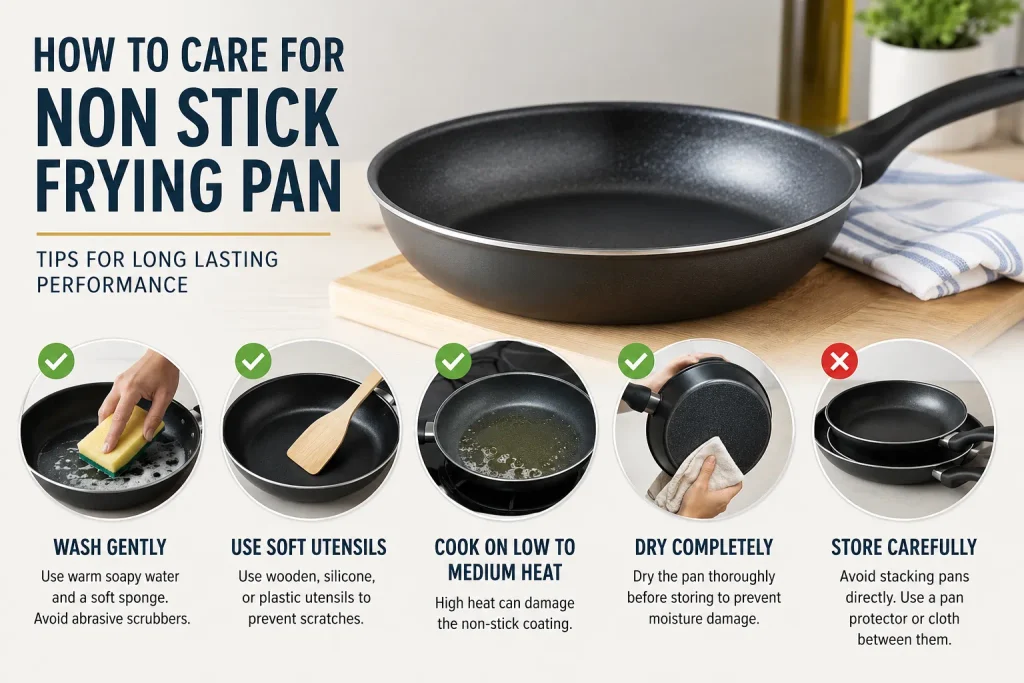
- Let the pan cool down completely before cleaning it. Cold water on a hot pan can warp the base.
- Wipe out excess oil or food with a paper towel first.
- Wash by hand with warm water, a few drops of mild dish soap, and a soft sponge or non-abrasive cloth.
- For stuck-on residue, soak the pan for 10 to 15 minutes instead of scrubbing hard.
- Rinse thoroughly and dry immediately with a towel to prevent water spots and mineral buildup.
- Store the pan somewhere it won’t get scratched by other cookware.
Many home cooks find that a quick wipe-and-wash right after cooking works better than letting a pan sit dirty, since dried-on oil is harder to remove without scrubbing.
Benefits of Taking Good Care of Your Non-Stick Pan
- Food releases easily with less oil, which helps with easier weeknight cleanup
- Even heating stays consistent, so eggs, pancakes, and fish don’t scorch in spots
- You get more use out of one pan instead of replacing cookware every year
- Fewer sharp or damaged edges means safer everyday cooking, especially with kids in the kitchen
Common Non-Stick Pan Problems and How to Fix Them
| Problem | Likely Cause | What Helps |
|---|---|---|
| Food suddenly sticks | Coating worn down by heat or scratching | Lower cooking heat, add a small amount of oil, avoid metal utensils going forward |
| Cloudy or hazy film | Cooking spray buildup or hard water residue | Wash with warm soapy water and a soft sponge; avoid aerosol cooking sprays |
| Dark or discolored spots | Overheating, often from empty-pan preheating | Preheat with a small amount of oil already in the pan, on medium heat |
| Coating flaking or peeling | Metal utensils, abrasive scrubbing, or pan is simply old | Stop using immediately for cooking and replace the pan |
| Warped bottom, doesn’t sit flat | Rapid temperature changes, like rinsing a hot pan in cold water | Let pan cool fully before washing; replace if warping is severe |
Common Mistakes That Ruin Non-Stick Pans
- Using metal spatulas or whisks — even careful use creates fine scratches over time
- Cooking on high heat — most non-stick coatings are designed for medium heat, not high
- Using aerosol cooking sprays — these often leave a sticky residue that’s hard to remove and can build up into that cloudy film
- Stacking pans without protection — bare metal-on-coating contact scratches the surface in storage
- Putting it in the dishwasher — harsh detergents and high heat wear coatings down faster, even on pans labeled dishwasher-safe
- Cutting food directly in the pan — a knife against a non-stick surface will damage it almost instantly
Non-Stick Pan Safety Tips and Best Practices
Beyond protecting the coating, a few safety habits matter for everyday cooking with non-stick pans:
- Never leave an empty non-stick pan on high heat unattended — overheating is the top cause of coating breakdown and can release fumes
- Use kitchen ventilation (a range hood or open window) when cooking at higher temperatures
- Stop cooking with a pan once the coating is visibly flaking or peeling, since flakes can end up in food
- Keep handles turned inward on the stovetop to avoid accidental spills, especially around kids
Safe Internal Cooking Temperatures When Using a Non-Stick Pan
Non-stick pans are commonly used for eggs, chicken, and ground meat, so it’s worth keeping food safety in mind alongside pan care. According to FoodSafety.gov, these are the general safe minimum internal temperatures:
| Food | Safe Minimum Internal Temperature |
|---|---|
| Eggs | 160°F |
| Ground meat (beef, pork) | 160°F |
| Poultry (chicken, turkey) | 165°F |
| Fish and seafood | 145°F |
| Beef, pork, lamb steaks or chops | 145°F, with a 3-minute rest |
A simple instant-read thermometer takes the guesswork out of this, which is especially helpful for beginner cooks still learning visual doneness cues.
Tools That Help Your Non-Stick Pan Last Longer
The right tools do a lot of the protective work for you. Here are a few worth having on hand.
Non-Stick Safe Utensils
Silicone Kitchen Utensil Set
Heat-resistant silicone won’t scratch coatings, making it one of the easiest upgrades for protecting a non-stick pan.Check Price on Amazon
Non-Abrasive Cleaning Tools
Soft Sponge and Non-Scratch Scrub Pad Set
Designed to lift stuck-on food without the abrasive texture of steel wool or rough scrub pads that wear coatings down.Check Price on Amazon
Pan Protectors for Storage
Felt Pan Protector Set
Slides between stacked cookware to prevent scratches, which matters most for anyone storing pans inside each other in a cabinet.Check Price on Amazon
Non-Stick vs Ceramic vs Stainless Steel: Which Needs the Most Care?
| Cookware Type | Cleaning | Heat Tolerance | Utensil Compatibility | Typical Lifespan | Best For |
|---|---|---|---|---|---|
| PTFE Non-Stick | Hand wash only | Low to medium heat | Silicone, wood, plastic only | 1 to 3 years with good care | Eggs, pancakes, fish, delicate foods |
| Ceramic Non-Stick | Hand wash only | Medium heat | Silicone, wood, plastic only | 1 to 2 years, coating fades faster | Everyday low-oil cooking |
| Stainless Steel | Dishwasher safe, can be scrubbed | High heat | Metal utensils fine | Many years, very durable | Searing, browning, high-heat cooking |
When to Replace a Non-Stick Pan
A non-stick pan is worth replacing once you notice any of the following:
- Visible scratches deep enough to see the metal underneath
- Flaking, peeling, or chipped coating anywhere on the cooking surface
- Food sticks consistently even with oil and low heat
- The pan wobbles or doesn’t sit flat on the stovetop
Most well-cared-for non-stick pans hold up well for one to three years of regular use. If you’re cooking with one daily, replacing it every couple of years is a normal part of kitchen maintenance, not a sign you did something wrong.
What Works Best for Busy Weeknight Cooks?
If you’re cooking dinner after a long workday, the goal is speed without ruining your cookware in the process. A few habits make the biggest difference:
- Keep one silicone spatula by the stove so you’re never tempted to grab a metal one out of habit
- Cook on medium heat instead of high — food still cooks quickly, and the pan lasts longer
- Wipe the pan down right after eating instead of letting it sit through dinner and dishes
- Skip the aerosol spray and use a small amount of oil from a bottle instead
Frequently Asked Questions
How often should I season a non-stick pan?
Most non-stick pans don’t need traditional seasoning like cast iron does. A light wipe of oil before cooking helps performance, but it isn’t required maintenance the way cleaning and gentle handling are.
Can I use metal utensils on a non-stick pan?
It’s best to avoid metal utensils entirely. Even careful use creates tiny scratches that add up over time and shorten the pan’s lifespan.
Why is my non-stick pan not non-stick anymore?
This usually comes from a combination of high heat, metal utensils, abrasive scrubbing, or cooking spray residue building up on the surface.
Is it safe to use a scratched non-stick pan?
Light surface marks are common and not usually a concern. Once the coating is flaking, peeling, or chipped, it’s time to stop cooking with that pan.
Can you put non-stick pans in the dishwasher?
Even if labeled dishwasher-safe, hand washing is gentler and helps the coating last longer. Dishwasher heat and detergent wear coatings down faster over time.
What oils are best for non-stick pans?
Butter, olive oil, and avocado oil all work well for everyday cooking. Aerosol cooking sprays are the one to avoid, since they tend to leave a sticky residue.
How long do non-stick pans typically last?
With good care, most non-stick pans last one to three years of regular use before the coating starts to wear down.
Conclusion
A non-stick pan doesn’t need complicated care, just consistent habits. Cook on medium heat, stick to silicone or wood utensils, hand wash gently, dry it fully, and store it where it won’t get scratched. Follow those steps and your pan will keep performing well long after the ones that skip this maintenance have already been replaced.