
By Michael Hayes | Recipe Talk Today
Quick Answer: No single date marks the invention. Cast iron cooking began in ancient China, Abraham Darby’s 1707 sand-casting patent made iron pots cheaper in England, and flat skillets spread with stoves in the 1800s. Lodge opened its Tennessee foundry in 1896.
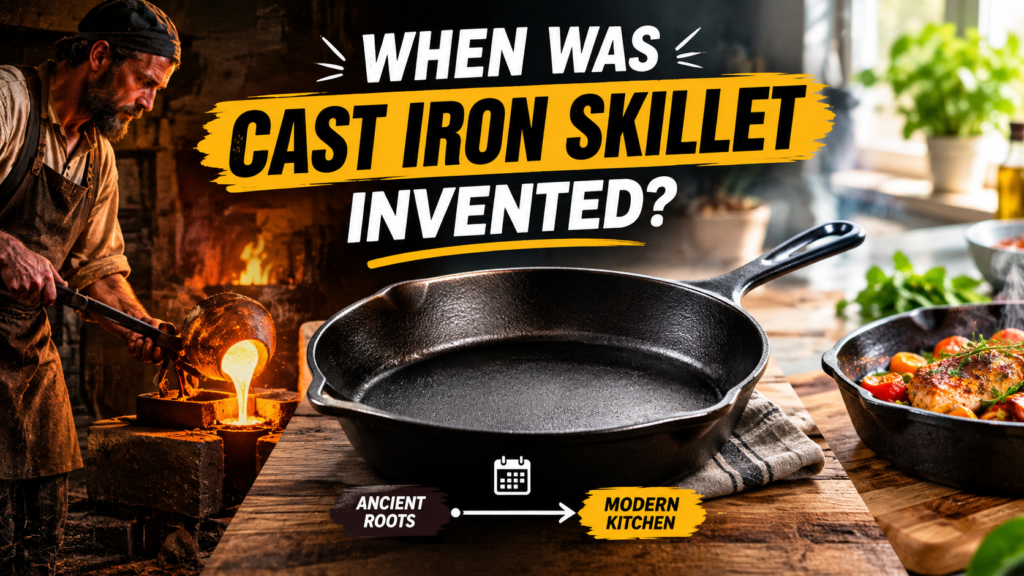
A cast iron skillet is one of the oldest cooking tools still used every day, so it is fair to ask when was cast iron skillet invented. The real answer is a story rather than a single date. This guide follows the pan from early Chinese foundries to an English patent and the American makers who filled home kitchens. You will see what the evidence supports, where sources disagree, and how to read the clues on an old pan.
Cast Iron History Abraham Darby Lodge Vintage Skillets
Disclaimer: This article is for informational purposes only. Always follow the manufacturer’s instructions and use kitchen tools and appliances safely.
The Short Answer: When Was the Cast Iron Skillet Invented?
Nobody can name an inventor or a year, because the skillet was never a single invention. It grew out of centuries of iron casting. Cast iron itself dates to ancient China, and cast iron cookware is generally traced to the Han Dynasty. Europe adopted cast iron later, and an English metalworker improved pot production in 1707. The flat-bottomed skillet most Americans know took shape as indoor stoves replaced open hearths.
Cast Iron Skillet History Timeline
| Period | Development | Why It Matters |
|---|---|---|
| 5th to 6th century BCE | Cast iron made in China | Iron could be poured into molds |
| Han Dynasty | Earliest known cast iron cookware | Cooking vessels join tools and weapons |
| 14th to 15th century | Cast iron reaches Europe | Foundries begin to spread |
| 1707 | Darby patents sand casting of iron pots | Thinner, cheaper cookware |
| 1896 | Lodge founds Blacklock Foundry | A major American maker begins |
Ancient Roots: Cast Iron Begins in China
Most sources agree that cast iron was first made in China, though they give slightly different dates. Some place it in the 5th century BCE and others in the 6th. Early Chinese foundries used it for tools, weapons and farm equipment. Cookware followed during the Han Dynasty, which ran from 206 BCE to 220 CE. That explains why you will see dates ranging from about 200 BCE to 220 CE for the first cast iron cookware.
One cookware history credits the Han era with the cast iron wok, first used to dry grains, and says stir-frying became its main job under the Ming Dynasty. Treat those specifics as one source’s account rather than settled fact. What is well supported is the bigger picture: Asia had a long tradition of cooking in cast iron vessels long before Europe.
From Foundry to Frying Pan: Four Stages
Cast iron is poured into molds for tools, then cookware.
Cast iron arrives by trade routes and spreads over several centuries.
Darby’s 1707 patent makes iron pots thinner and cheaper.
Stoves and foundries make the flat skillet a household staple.
Europe and Abraham Darby’s 1707 Patent
Cast iron reached Europe by trade routes around the 14th century, and at first it was mostly valued for military goods. Cookware was thin on the ground and expensive. That changed with Abraham Darby I. According to one account, he visited Holland in 1704 and saw the Dutch casting brass vessels in sand rather than clay or loam. He applied the idea to iron and, in 1707, applied for a patent for casting iron bellied pots in sand only.
The patent made pots and kettles thinner and cheaper than rivals could manage, and Darby founded the Coalbrookdale Company in 1709. Readers asking when was cast iron skillet invented often land on Darby, but his patent covered pots, not skillets. His real contribution was cheap, repeatable production, which put iron cookware within reach of ordinary households.
From Hearth to Stovetop: How the Skillet Took Shape
Early iron pots often had three or four feet so they could sit in hearth coals, and many hung from hooks. The flat bottom came later. Once indoor stoves arrived, cookware could sit directly on the cooking surface, and stove makers began producing pans sized for their own products. This is the stage when the skillet we recognize took hold, which is why a precise invention date does not exist.
Hearth Pot vs. Stovetop Skillet
Legs or a hanging hook
Sits in or over open coals
Deep, rounded shape
Flat bottom for a stove surface
Shallow sides and a long handle
Sized to fit stove burners
Where Sources Disagree
| Topic | What Sources Say | How to Read It |
|---|---|---|
| Start of cast iron | 5th or 6th century BCE | Same era, slightly different dating |
| First cookware | About 200 BCE to 220 CE | Han Dynasty window |
| Darby’s breakthrough | 1707 patent; some say 1710 | 1707 is the documented patent date |
| Skillet inventor | No credible single name | Gradual evolution |
American Skillet Makers: Lodge, Griswold and Wagner
Cast iron cookware was especially popular with American homemakers during the first half of the 20th century. It was cheap and durable, and most households owned at least one pan. Three names dominate the story. Joseph Lodge started the Blacklock Foundry in South Pittsburg, Tennessee, in 1896, naming it for his friend and minister. It made stoves, sad irons, tea kettles and kitchen sinks, but cookware became the bread and butter of the business.
A fire destroyed the foundry in May 1910, and about three months later the company reopened under the Lodge name. Griswold and Wagner were other well-known makers. Wagner later made pans under both brands, and its foundry closed in 1999.
Major American Makers at a Glance
| Maker | Key Fact | Status |
|---|---|---|
| Lodge | Founded 1896 in South Pittsburg, Tennessee | Still operating, family-owned |
| Griswold | Reputation for high quality | Name phased out by early 1970s; prized by collectors |
| Wagner | Also produced Griswold-pattern pans | Foundry closed 1999 |
Why Old Skillets Feel Different
Collectors prize vintage Griswold and Wagner pans for smooth cooking surfaces and relatively light weight. Even Lodge made smooth, hand-poured skillets before about 1950, according to one vintage-cookware retailer. Many current mass-market pans keep a rougher, as-cast texture, while some newer boutique makers machine their surfaces smooth. Cooks disagree on whether smoothness changes results in practice, so treat it as a matter of feel and preference.
Vintage vs. Modern Skillets
| Feature | Vintage | Modern Mass-Market |
|---|---|---|
| Cooking surface | Often smooth | Often rougher texture |
| Weight | Often lighter | Often heavier |
| Seasoning | Usually needs re-seasoning | Often sold pre-seasoned |
| Collectibility | High for some marks | Generally low |
Why the Skillet Design Lasted
Pans can last for generations.
Holds heat for long periods.
Can double as a baking dish.
Old pans can be cleaned and re-seasoned.
Cheap to make since Darby’s era.
A proper seasoning guards against rust.
Decline, Comeback and Pre-Seasoned Pans
Cast iron fell out of favor in the 1960s and 1970s as other materials gained ground, then returned in specialty markets. One reference reports that Lodge was the first maker to season its cookware at the foundry, in 2002. That detail is worth confirming with the manufacturer, but it explains why today’s skillets arrive ready to cook, while older pans usually need seasoning first.
How to Estimate Your Own Skillet’s Age
Maker’s marks and pattern numbers cast into the bottom let collectors date and attribute pans. You can start with four simple checks, though identifying a pan with certainty usually takes a collector’s guide.
Four Clues to Check on the Bottom
Look for a maker’s mark such as Lodge, Griswold or Wagner.
A cast number helps identify the model.
Smooth often suggests an older or machined pan.
Some older pans have a ring on the bottom, though not all.
Caring for a Historic Pan
Clean it soon after cooking, once cool
Dry it completely
Re-season if the surface looks dull or bare
Leaving it soaking in the sink
Heating a cracked or warped pan
Grinding off the bottom or its markings
Quick Reference: Who, Where and When
| Question | Short Answer |
|---|---|
| Where did cast iron begin? | China |
| Who patented sand-cast iron pots? | Abraham Darby, in 1707 |
| Who founded Lodge, and when? | Joseph Lodge, 1896 |
| Who invented the skillet itself? | No single inventor is documented |
Sources for Further Reading
For more detail, see Lodge’s own company history, the overview of cast-iron cookware on Wikipedia, and the entry on Griswold Manufacturing.
Frequently Asked Questions
Who invented the cast iron skillet?
No single person did. Cast iron cookware began in ancient China, Abraham Darby improved pot casting in England in 1707, and the flat skillet evolved as stoves became common.
Did Abraham Darby invent the cast iron skillet?
Not exactly. In 1707 he patented a method of casting iron pots in sand, which made cast iron cookware thinner and cheaper. That helped later skillet production, but he is not credited with inventing the skillet itself.
How old is cast iron cookware?
Sources place the first known cast iron cookware in China during the Han Dynasty, with dates ranging from about 200 BCE to 220 CE. Cast iron itself appeared in China several centuries earlier.
When did Lodge start making cast iron?
Joseph Lodge founded the Blacklock Foundry in South Pittsburg, Tennessee, in 1896. After a fire in 1910 it was rebuilt and renamed Lodge Manufacturing.
Why are older cast iron skillets smoother?
Many vintage makers, including Lodge before about 1950, poured skillets by hand and finished the cooking surface smooth. Many modern skillets keep a rougher, as-cast texture, though some makers machine theirs smooth.
When did skillets start coming pre-seasoned?
Lodge is reported to have been the first major maker to season cookware at the foundry, in 2002. Check the manufacturer for details on any specific pan.
Is a vintage cast iron skillet safe to use?
Often yes if it sits flat with no cracks, warping or heavy pitting. Clean it thoroughly, re-season it, and follow the manufacturer’s care guidance. Avoid heating a cracked pan.
Final Thoughts
So, when was cast iron skillet invented? There is no single date, only a long chain of improvements: Chinese casting, Darby’s 1707 patent, the arrival of stoves, and American foundries like Lodge from 1896. Knowing that history helps you shop smarter and care for old pans with more confidence. Whether you pick up a modern pre-seasoned skillet or restore a vintage one, you are using a design refined over centuries.
